



Artificial Intelligence is no longer a concept of the distant future, it’s already changing the way students learn every day. Just consider the immense challenge a teacher faces in trying to support multiple students, each of whom has their own pace, strengths, and weaknesses. This is the point where AI in education comes to the rescue. It does not replace teachers; it gives them more power.
With a well-planned digital transformation strategy, AI can facilitate effective learning experiences that students perceive as being more personal, more interesting, and more effective. Moreover, with the help of a proficient AI development company, educational institutions can make the classroom a place where every student receives the attention and support they need.
In this article, we’ll explore what AI in education truly means today, how virtual learning environment reshaping schooling worldwide, and provide meaningful insights and measurable outcomes.
So, let’s dive in!

What is AI in Education?
AI in education is a radical transformation of the education system. It does the very necessary but often overlooked tasks that are time-consuming, like grading, attendance, scheduling, and report generation, thus allowing educators to spend more time on human connection and personalized instruction.
The benefits of AI in education have surpassed the goal of mere efficiency, they are now assisting the emotional aspect of the learning process, student outcomes are getting better, and more equality is being brought to the learning environments.
In fact, intelligent tutoring systems is a smart system that modifies a student’s learning according to their speed, style, and strengths, making education more personalized, interactive, and engaging.
AI is redefining learning through innovations such as:
- Virtual tutors & intelligent assistants
- Interactive and immersive learning platforms
- Predictive analytics for performance insights
- Smart content that evolves based on learner growth
These advancements highlight the growing benefits of AI in education, especially as institutions embrace a stronger digital transformation strategy. The shift isn’t temporary, AI is becoming a long-term foundation for digital transformation in the academic world.
AI doesn’t just change how students learn, it transforms how institutions operate, thanks to strategic collaborations with every modern AI development company focused on future-ready education technology.
Also read: How is Digital Transformation Shaping Customer Experience
The Driving Forces Behind AI Adoption in Education
1. Demand for personalized learning at scale
Different students have different ways of learning, and an AI-driven education system is the only way to provide a personalized experience for each learner. One of the major advantages of artificial intelligence in education is the ability to deliver scalable customization which makes the teaching process adaptive without the need for additional teachers.
2. Growing administrative burden on faculty and staff
Educators spend nearly 40% of their time on tasks that don’t involve actual teaching. AI automation significantly reduces these tasks, improving productivity and supporting digital transformation strategy across institutions.
3. Pressure to improve student success metrics
Artificial Intelligence is the major factor that enables the identification of students who are having a hard time at an early stage and thus making it possible to give them support before things get worse. As a result, this brings better grades, excellent retention, and improved learning outcomes. Therefore, AI advantages in education are the key factors of success and the capability to be ready for the future.
4. Evolving expectations for learning experiences
Today learners require personalized learning platform , instant help, and continuous support. As a result of a broader digital transformation, AI is instrumental in education to provide fast and flexible experiences that students expects in this technology-driven world.
How AI in Education Can Help Teaching and Learning
Is AI helping in teaching and learning?
Yes, and its impact is expanding every day.
Across the USA, AI in education updates show that K-12 teachers, especially in middle and high schools, have begun integrating AI tools directly into instruction. Nearly 23% of districts have already offered AI in learning to teachers, and another 37% plan to do so, reflecting strong momentum driven by the benefits of AI in education. More than half of the teachers using AI rely on generative chatbots like ChatGPT for creating lesson ideas, feedback, and classroom support.
This rapid rise proves that AI in education is not a future prediction, it’s already transforming classrooms thanks to smarter solutions built by every leading AI development company. Let’s explore how:
1. Learning the Way You Understand
Personalization is one of the strongest benefits of AI in education. With data-driven insights, AI platforms adapt lessons to student proficiency, interests, and pace, making learning more inclusive and engaging.
These advancements are a direct result of digital transformation reshaping teaching methods at scale.
2. Real-Time Feedback that Improves Progress
AI models review work quickly and highlight:
- Strengths
- Weak areas
- Recommendations for improvement
This helps teachers plan interventions sooner and provides learners the confidence to keep improving. Such instant evaluation is a key advantage shared in many AI in education updates across global institutions.
3. Content Creation with AI, But Mindfully
AI can generate quizzes, assignments, revision guides, and even presentations with a well-crafted prompt. It unlocks creativity and productivity, making it one of the most practical benefits of AI in education.
However, rules matter:
Don’t let AI think for you, make it work for you.
Some institutions prohibit AI-generated content for grading, which brings forward the pros and cons of AI in workplace and education. Responsible use is essential.
4. Chatbots for Student Support, Help Anytime
AI chatbots are now a 24/7 companion for students. They assist with:
- Admissions and enrollment questions
- Course materials and deadlines
- Study planning and reminders
- Writing and skill-building assistance
These solutions, powered by modern AI development company innovations, free up faculty time and reinforce accessibility, a major win in the evolving landscape of digital transformation.
Also read: Impact of AI in Digital Transformation
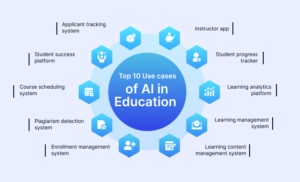
Detailed Overview of AI Use Cases in Education
1. Instructor App, Smarter Teaching Workflows
As AI continues to expand in the educational sector, instructor applications are gradually becoming more capable of handling routine administrative chores, reducing the faculty’s burden, and improving the level of teaching. Such mechanisms serve as a gateway to the advantages that AI brings to the educational field as they allow teachers to dedicate more time to student-centered learning, which is the topmost concern of every digital transformation strategy.
Key AI capabilities:
- AI-assisted grading & feedback
- Personalized student guidance
- Automated communication
- Real-time class performance analytics
A leading AI development company builds these instructor apps to create future-ready classrooms.
2. Plagiarism Detection System, Protecting Academic Integrity
Modern AI in education tools goes far beyond basic text matching, supporting institutions during the rapid digital transformation of learning content.
Advanced capabilities:
- Semantic understanding to detect paraphrasing
- AI-generated content recognition
- Cross-language plagiarism insights
- Writing style analysis to detect mismatches
These solutions are now essential, especially with the ongoing debate around the pros and cons of AI in the workplace and education.
3. AI-Driven Course Scheduling System
Academic scheduling has always been a complex optimization task, now revolutionized by AI tools from expert AI development company partners.
Core strengths:
- Massive constraint optimization
- Enrollment demand forecasting
- Real-time rescheduling
- Conflict reduction for graduation pathways
Scheduling is becoming a measurable benefit of AI in education as institutions accelerate digital transformation strategy initiatives.
4. Enrollment Management System, Smarter Recruitment
With predictive analytics at its core, this system turns guesswork into smart strategy, a transformation highlighted in numerous AI in education updates.
Capabilities include:
- Predictive yield modeling
- Personalized recruitment messaging
- Financial aid optimization
- Retention risk detection
This ensures AI in education supports the entire student lifecycle, not just academics.
5. Learning Analytics Platform, Data to Action
As institutions adopt full digital transformation, AI turns data into insight.
What it delivers:
- Behavioral learning pattern recognition
- Concept mastery diagnostics
- Performance forecasting
- Curriculum effectiveness evaluation
These analytics highlight the benefits of AI in education through higher student success rates and stronger interventions.
6. AI-Enhanced Learning Content Management System
AI ensures the right learning materials reach the right students at the right moment, a key pillar of digital transformation strategy.
Capabilities:
- Autonomous tagging and resource organization
- Personalized content suggestions
- Accessibility and quality checks
- Automated content adaptation (summaries, questions, etc.)
A top AI development company builds intelligent ecosystems that eliminate content chaos.
7. AI-Powered Learning Management System
Unlike traditional LMS platforms, AI-integrated LMS solutions personalize learning based on mastery and pace, one of the most recognized benefits of AI in education.
Adaptive features:
- Custom learning paths
- Dynamic difficulty adjustments
- Contextual tutoring and hints
- Mastery-based progression
These improvements frequently appear in AI in education updates by EdTech innovators.
8. Student Progress Tracker, Growth Visibility
AI-powered tracking platforms reveal actual competency growth, not just grades.
Functional strengths:
- Competency mastery detection
- Targeted remediation insights
- Predictive progress trajectories
- Personalized goal support
This AI-first approach aligns with global digital transformation in education quality measurement.
9. AI-Powered Student Success Platform
Success requires coordinated support, AI enables exactly that.
What AI improves:
- Early warning systems for drop-out risk
- Smart intervention routing
- Institution-specific success factor analytics
- Outcome-based strategy enhancement
A practical example of how AI in education solves retention challenges at scale.
10. AI-Driven Applicant Tracking System
Admissions offices rely increasingly on AI to maintain speed and fairness, a promising area in AI in education updates.
Top capabilities:
- Automated document extraction
- Holistic applicant scoring with contextual fairness
- Enrollment probability predictions
- Bias detection and equitable decision-making
These innovations reveal both the pros and cons of AI in workplace and education, showing the importance of ethical oversight.
Conclusion
AI is changing the education system of tomorrow by offering students personalized learning, making the teaching process more efficient, and helping institutions become more data-driven. The advantages of AI in education are evident: improved results, lessened workloads, and more intelligent decision-making. As AI in education updates keep on progressing, the emphasis should still be on the accountable use of AI and a well-thought-out digital transformation plan that gives both teachers and students the power.
The future of learning is here. Let’s build it together.